Failed Auction Reversal
Price tests a key level but cannot continue the auction. After reclaim, QFE Pro looks for futures orderflow evidence that supports a reversal away from the failed area.
Test & fail → reclaim → reversalV2.0 narrows the decision process into three focused setup families — FAR, DPC and ABR. The framework starts with auction location, waits for a potential entry zone, then uses Gold Futures orderflow context to confirm whether the setup is ready for the trader to evaluate.
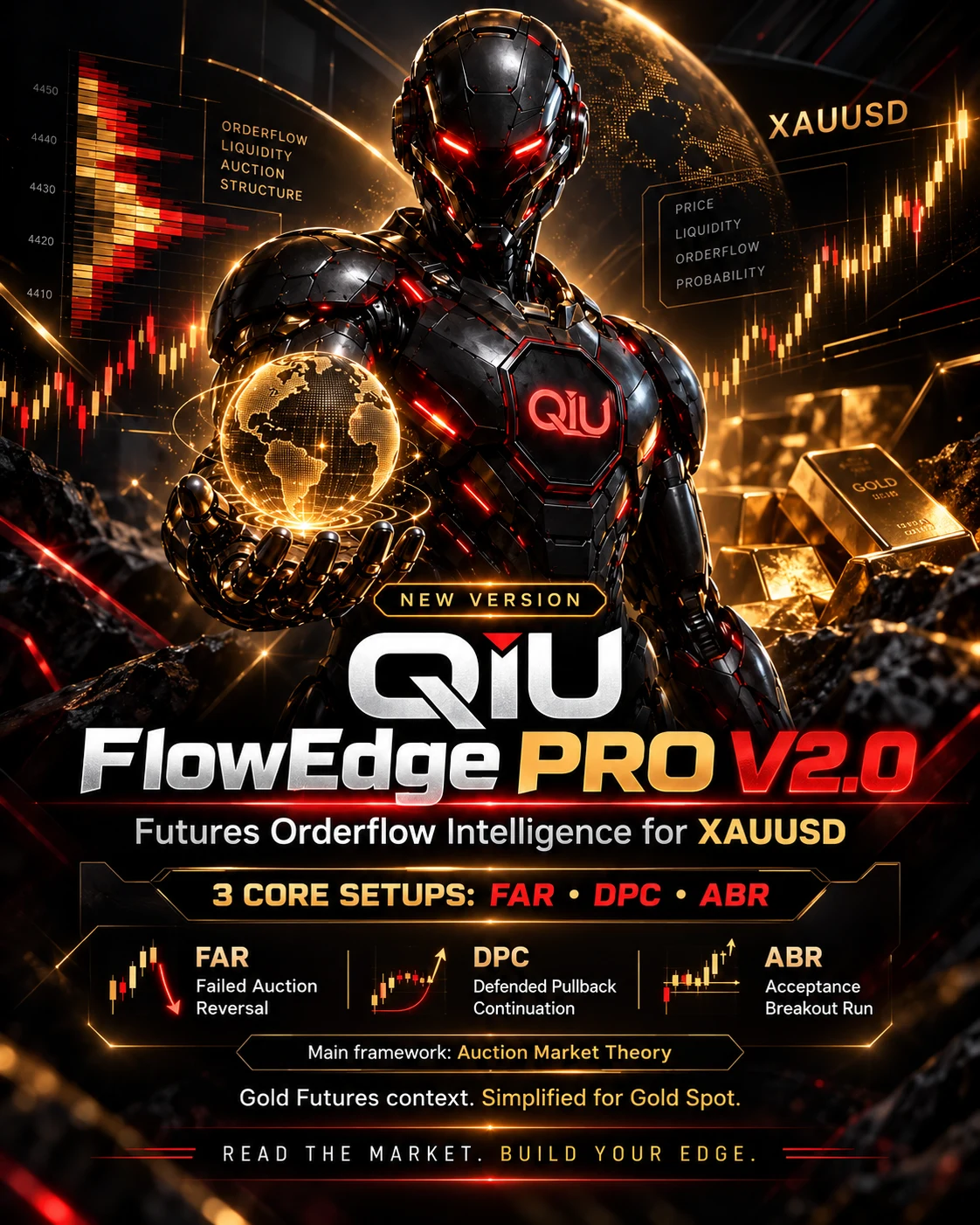
QFE Pro V2.0 focuses on repeatable auction behavior. It uses Gold Futures orderflow context to support XAUUSD / Gold Spot decisions. The futures feed provides the orderflow evidence; QFE Pro does not claim that XAUUSD itself has a centralized order book or centralized volume feed.
The names are simple; the confirmation underneath remains orderflow-driven. Each setup starts from a different auction condition and only becomes meaningful at the right location.
Price tests a key level but cannot continue the auction. After reclaim, QFE Pro looks for futures orderflow evidence that supports a reversal away from the failed area.
Test & fail → reclaim → reversalPrice pulls back into a defended zone while the larger directional auction remains intact. Orderflow must show that the area is being defended before continuation is considered.
Trend → pullback → defence → continuationPrice moves beyond value or a meaningful boundary and shows acceptance rather than immediate rejection. QFE Pro then looks for continuation flow toward the next auction area.
Break → accept → expandV2.0 is designed to prevent a setup from becoming active only because price moved. The intended sequence is: identify the auction location, wait for price to reach the Potential Entry Zone, then confirm the orderflow before activation.
Key level, value edge, defended area or auction boundary.
Wait for price to interact with the area where the setup becomes relevant.
Use Rithmic futures flow to confirm defence, failure, acceptance or continuation.
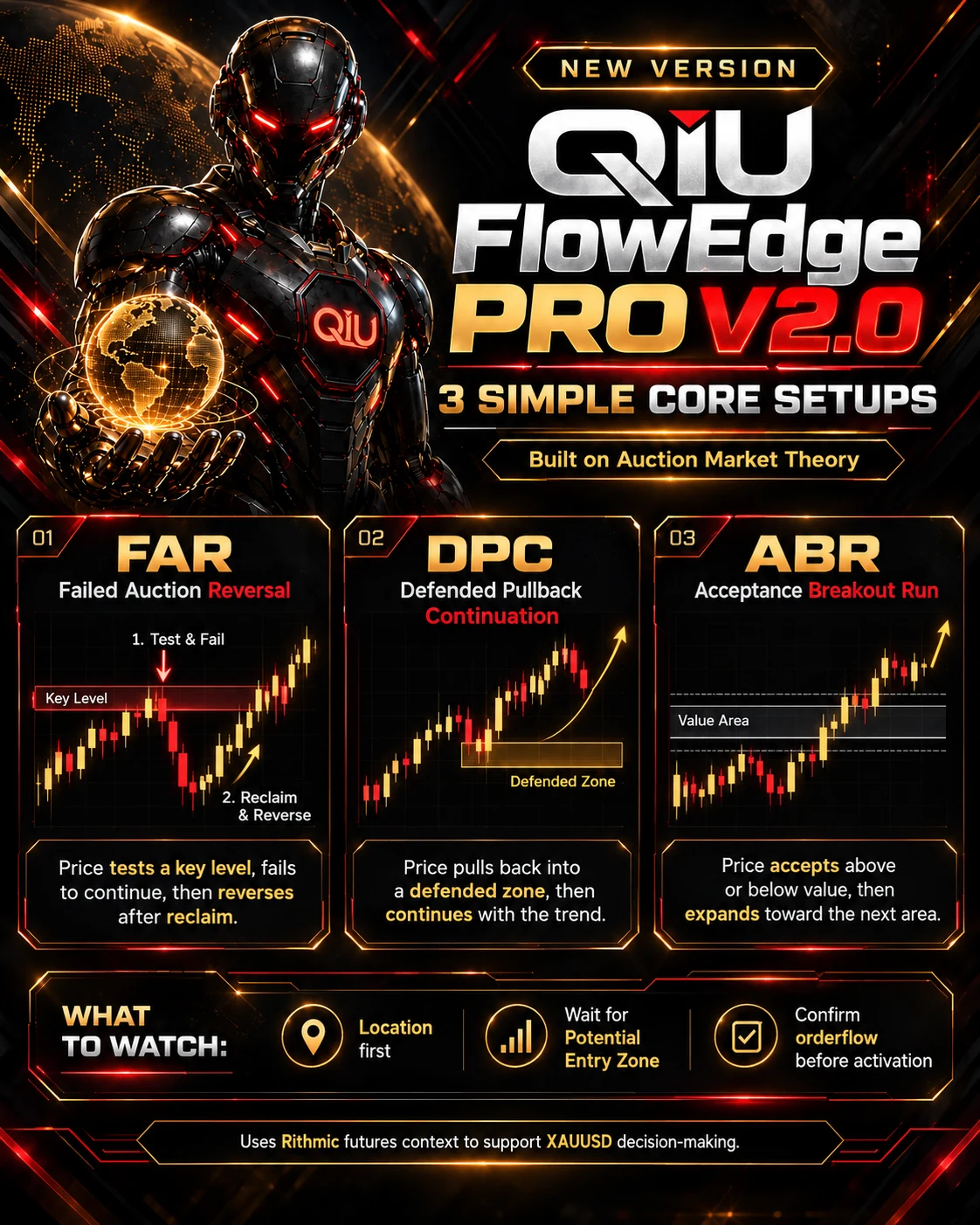
FAR, DPC and ABR simplify the setup classification. The underlying confirmation still comes from multiple futures orderflow layers working together around the auction location.
Tracks whether executed buying or selling supports the setup direction and whether cumulative flow agrees with price.
Uses POC, VAH, VAL, LVN and value migration to frame whether price is accepting or rejecting an auction area.
Highlights meaningful executed size, tape acceleration and participation shifts near the setup location.
Reads pulling, stacking and visible liquidity behavior to help qualify defended zones and breakout conditions.
Looks for aggressive flow that is being absorbed or losing efficiency, especially around FAR and DPC decision points.
Keeps every setup anchored to the auction structure instead of treating isolated orderflow events as standalone trade signals.
QFE Pro does not need to call every market move. It waits for one of the three setup families to form in the right place and then checks the flow around that location.
Key level, value boundary, defended zone or acceptance area.
Define where price must interact before the setup can progress.
Check defence, failure, acceptance, pressure and participation from the futures feed.
Present the setup for the trader to evaluate against risk and execution rules.
When location and orderflow align, QFE Pro organizes the evidence into a compact trade context rather than forcing the trader to interpret every raw futures metric independently.
The V2.0 framework is intentionally concentrated around three repeatable auction conditions instead of presenting a large collection of loosely related setup names.
Focuses on rejection, failure to continue and reclaim around meaningful levels.
Focuses on a pullback into an area where orderflow still supports the prevailing auction.
Focuses on breakout conditions where price accepts beyond value and continues toward the next area.
Orderflow can improve context, but it cannot remove trading risk. QFE Pro V2.0 does not guarantee a winning trade, does not execute trades automatically and does not replace risk management. Market conditions, feed quality, spreads, latency and execution can affect results.
Read the market. Build your edge.